


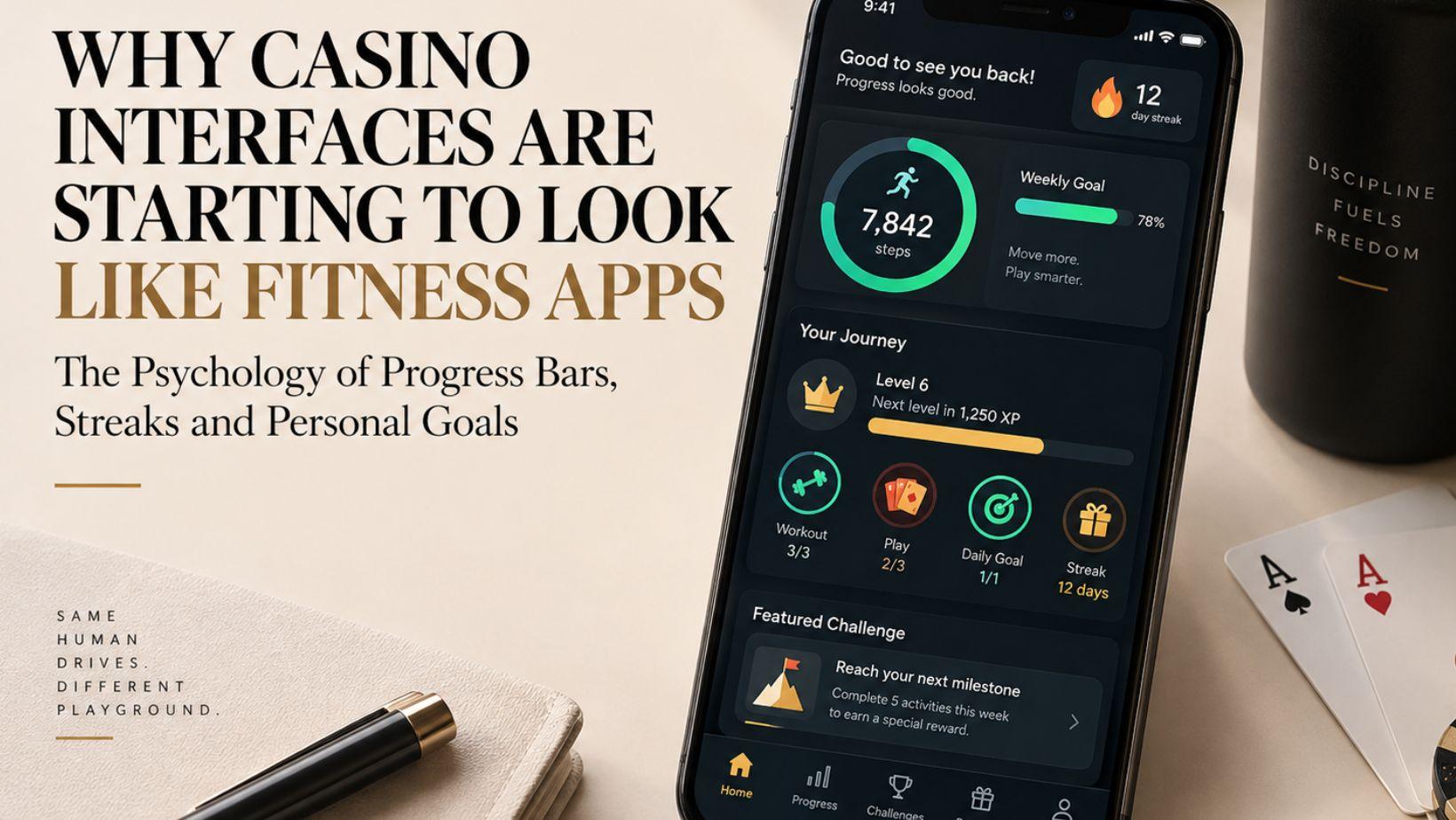
Open a modern fitness app and you may see a progress bar, daily target, achievement badge, activity streak and personalized dashboard. Open some contemporary online gaming platforms and the visual language can look surprisingly familiar. Casino sites increasingly use levels, milestones, loyalty progress and instant feedback to organize the user experience around a sense of progression. Players comparing how different platforms structure these features may encounter resources such as Casino Ranking on gamerules.com, while the broader trend raises a more interesting question: why have two industries with completely different purposes adopted so many of the same interface ideas?
The answer lies largely in gamification: applying elements associated with games to activities that are not necessarily games themselves. Fitness applications use it to make repetitive behaviors such as walking, exercising or logging meals feel measurable and rewarding. Casino platforms can use similar mechanics to transform a collection of individual gaming sessions into a longer-term digital journey.
The resemblance is not accidental, but the psychology behind it deserves a closer look.
The progress bar turns activity into a journey
A progress bar is an extremely simple interface element. It shows where someone is now and how far remains before reaching a defined target.
In fitness, the target might be 10,000 steps, five workouts in a week or completion of a training program. In a casino interface, progression may instead be linked to loyalty status, experience points, missions or unlocking another tier.
Research into health and fitness apps shows how widespread this broader gamification approach has become. One study examining popular health and fitness applications found gamification in 64% of the apps assessed. Goal setting appeared in 78% of the gamified apps, while challenges were present in approximately 63%.
Why does displaying progress matter?
Because an abstract activity becomes a visible path. Instead of simply completing another workout—or another interaction with a gaming platform—the user sees movement toward something.
Progress bars can therefore create a sense of continuity between otherwise separate actions. Research into digital motivational systems has similarly noted that visual indicators such as progress bars, badges, points and streaks can highlight previous achievement and encourage users to continue toward established goals.
Streaks make yesterday relevant today
A streak works differently from a simple reward.
If an app says you have exercised for six consecutive days, today’s activity is no longer isolated. Skipping it potentially breaks something you have already built.
That makes streaks powerful because they connect past behavior to a present decision.
Fitness platforms have used this idea extensively to encourage consistency. A workout, walk or daily check-in becomes one piece of a longer record. The attraction is not necessarily the individual activity but maintaining continuity.
Casino and gaming interfaces can borrow the same logic through consecutive-day rewards, recurring missions or loyalty structures that recognize ongoing activity.
The underlying behavioral mechanism is similar even though the activities themselves are very different: the interface gives continuity a visible value.
This distinction is important. The user is no longer evaluating only, “Do I want to do this now?” There is another consideration: “Do I want to lose the progress I have already established?”
That makes streak design effective, but it also explains why designers need to use it responsibly—especially in environments involving real-money gambling.
Personal goals create a feeling of ownership
Generic targets are useful, but personalized objectives can be even more engaging.
Fitness apps increasingly adapt dashboards to the individual. One person may be trying to improve running distance while another tracks strength training or weight management.
Studies of fitness technology suggest that features supporting feelings of autonomy, competence and social connection can be associated with exercise-related engagement. One analysis of 682 fitness-app profiles found that technological features connected with these psychological needs predicted different workout outcomes.
Digital gaming platforms can apply a comparable interface philosophy.
Instead of giving everyone exactly the same journey, users may see personalized missions, recommendations, status levels or reward paths. This creates the impression that the platform is responding to their individual activity rather than presenting an identical menu to every visitor.
From a UX perspective, personalization reduces the distance between the user and the interface.
“My dashboard” feels different from “the homepage.”
Achievements make invisible activity visible
Badges and achievements perform another function: they convert behavior into symbols.
A fitness user may receive an achievement for completing a first 5K or reaching a monthly activity target. The achievement itself has little practical value, but it provides a permanent representation of something that happened.
Gaming platforms have understood this principle for decades.
Online casinos and gambling-adjacent gaming environments increasingly package activity through similar visual markers: levels, badges, status tiers and milestones. Befitnatic has previously examined this “leveling up” structure, noting how contemporary casino platforms can present users with profiles, milestones and progression systems that resemble video-game journeys.
This changes how the interface frames time.
Without progression mechanics, each session can feel independent. With achievements, the user accumulates a history.
Yesterday’s activity becomes part of today’s profile.
Instant feedback keeps the interface alive
There is another similarity between fitness technology and casino UX: both provide feedback very quickly.
Complete a workout and the screen may immediately display calories, distance, personal records or progress toward a weekly objective.
Modern digital gaming environments also respond instantly. A status bar moves. Points appear. A mission updates. A new level becomes available.
Immediate feedback matters because users do not have to remember whether their behavior is producing progress. The interface continuously tells them.
Research into gamified health applications has found that feedback and monitoring are among the most common behavior-change techniques used by such platforms. One systematic review found feedback and monitoring in 94% of the analyzed apps that met its criteria, alongside widespread use of goals, planning and rewards.
In UX terms, the interface is constantly answering a simple question:
What did my last action change?
Leaderboards add the social comparison layer
Fitness is often an individual activity, but fitness apps have turned it into a social one.
Users compare step counts, participate in challenges and sometimes compete on leaderboards.
Casino platforms can use comparable structures around tournaments, status systems or competitive events.
A recent experimental study examining progress bars and leaderboards found that these gamification elements can influence engagement and contribution behavior, although their effects depend on whether users are participating individually or within teams.
Social comparison provides information that a simple progress bar cannot.
A progress bar says: “You are 80% complete.”
A leaderboard says: “You are ahead of—or behind—other people.”
The second message creates an entirely different motivational environment.
Similar interfaces, very different objectives
The resemblance between fitness and casino apps should not obscure a fundamental difference.
A fitness application generally uses gamification to encourage behaviors such as exercise, activity tracking or adherence to health goals. Real-money casino activity involves financial risk, making the ethical consequences of engagement design substantially different.
The same UX mechanism can therefore have different implications depending on where it is used.
A streak encouraging someone to take a daily walk is not equivalent to a streak encouraging repeated gambling activity.
That distinction makes transparency, spending controls, time limits and responsible-gambling tools especially important when casino platforms borrow engagement techniques from other digital industries.
The wider shift toward “progress-based” interfaces
What fitness applications and modern casino platforms ultimately share is a broader transformation in digital design.
Apps increasingly avoid presenting themselves as static collections of functions. Instead, they attempt to create journeys.
Progress bars show direction. Streaks connect one day to another. Achievements preserve a history of success. Personalized objectives give users something specific to pursue. Dashboards bring all those signals together in one place.
Fitness technology adopted these tools because exercising repeatedly can be difficult to sustain. Gaming platforms use them because structured progression can make digital experiences feel more continuous and personalized.
Research even suggests that gamified competition can affect real-world behavior: a large-scale study of roughly 2,500 walking competitions found that average physical activity increased by 23% during the challenges studied.
That does not mean every progress bar or badge automatically changes behavior. Studies repeatedly emphasize that gamification effectiveness depends heavily on implementation.
But it explains why these design elements appear almost everywhere.
The modern interface no longer merely tells users what they can do. Increasingly, it tells them where they are, what they have achieved and what comes next.
And that is why a fitness dashboard and a casino lobby can sometimes look like distant relatives: both are products of a digital economy in which visible progress has become one of the most powerful ways to structure engagement.