


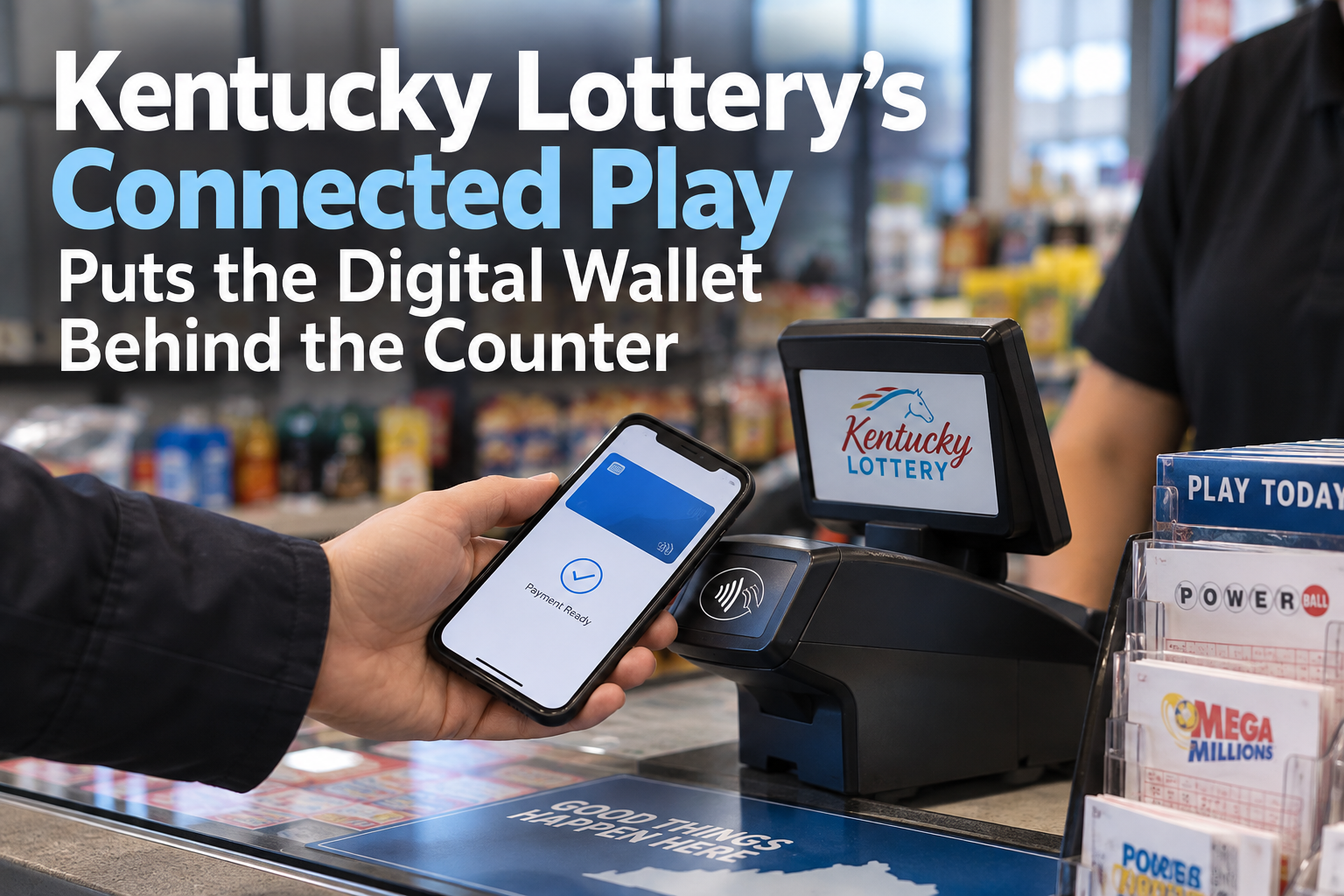
Kentucky Lottery Connected Play lets a player pay for scratch-offs, draw games and Fast Play tickets at any of the state's 3,500 retail locations using money already sitting in their Fun Club online account. A QR code inside the lottery app works as the payment instrument, at the counter or at a self-service vending machine. The Lottery says no other operator in the country does this.The feature went live in February 2026, when Kentucky finished converting to a new central gaming system and closed out a retail modernization effort. That programme replaced terminals, vending machines, ticket checkers, printers and marketing monitors across more than 3,500 retail locations. The consumer campaign followed in May, a month after the state marked ten years of legal online lottery sales.
For players interested in taking part in Kentucky Lottery games, this kind of information is also useful when comparing current offers and understanding how the online and retail systems work together. Resources covering a real kentucky lottery promo code can provide additional context on available promotions, eligibility conditions and the practical steps involved before playing.
What actually happens at the counter
The player opens the Kentucky Lottery app, navigates to the Virtual Player Card, and presents the QR code at a retailer terminal or a self-service vending machine, paying from the Fun Club eWallet balance. Scratch-offs, draw games and Fast Play tickets are all eligible, and there is no extra cost for paying this way. Several constraints are worth knowing before anyone writes about this as friction-free retail. Only one payment method can be used per transaction, Fun Club bonus funds cannot be used at retail at all, and a low balance returns an insufficient balance message prompting either another method or a top-up at the retail terminal. The shopping cart handles a maximum of 30 items before a second session begins. The flow also runs the other way. Mobile Cashing lets a player scan a winning retail ticket worth up to $600 and deposit the prize straight into the Fun Club account. Most claims process within minutes, though the transfer onward to a bank account can take up to two business days. Those funds are available immediately and sit in what the Lottery calls the winnings pocket.
The real asset is the transaction record, not the convenience
Every retail purchase made with the player card is tracked, and players can review those retail transactions in their transaction history. That single detail is the reason operators want this, and it rarely makes the consumer coverage. State lotteries have spent four decades selling through anonymous cash transactions at convenience stores. They know what a store sold and when. They do not know who bought it. An account-linked retail purchase converts an anonymous ticket into an identified one, which makes segmented promotions, cross-channel second-chance mechanics and lifetime value modelling possible for the part of the business that still produces most of the revenue. In fiscal 2025, retail accounted for 62% of Kentucky's sales while the iLottery channel set its own record at more than $828 million. Kentucky Lottery President and CEO Maggie Garrison framed it plainly for a Lexington television audience in May, saying the feature "really pulls together the online channel with the retail channel".
Kentucky is first to launch, but it did not build this alone
Connected Play is not a Kentucky invention. It is a named capability inside the omnichannel platform sold by Brightstar Lottery, marketed as the way to bridge retail and digital channels. Brightstar is the company that emerged in 2025 when IGT sold its digital and gaming business and renamed itself as a pure play lottery operation. Kentucky described the plan a year before launch. In trade press it said the upgraded iLottery platform, together with retail equipment upgrades coming the following fiscal year, would let it implement its supplier's Connected Play features, including using funds stored in the digital lottery wallet to buy at retail and adding funds from winning retail tickets back into the wallet. The two contracts underpinning that work run to 2036 and cover a central system upgrade to the supplier's Aurora platform, new point-of-sale hardware for thousands of Kentucky retailers, and an upgraded cloud-based iLottery system. That matters for anyone forecasting how quickly this spreads. Brightstar is the primary technology provider to 26 of the 46 lottery jurisdictions in the United States. A first-to-market claim in Kentucky is a product launch, not a moat. The question worth asking is which of those 26 jurisdictions has the terminal estate, the cashless plumbing and the regulatory appetite to follow.
The hardware numbers are more persuasive than the wallet numbers
Kentucky has not published adoption figures for Connected Play itself. No eWallet transaction counts, no share of retail sales paid from account balances, no player card activation rate. Until it does, the strongest evidence for the strategy sits one layer down, in the equipment. After Kentucky upgraded more than 700 retailers from 24-game vending machines to larger 28-game units with cashless payment capabilities, those locations recorded an average sales increase of 58%. That figure comes from industry reporting on the modernization programme rather than a wallet-specific study, and it bundles together more facings, better merchandising and card acceptance. It still sets the benchmark any Connected Play result will be measured against. The surrounding fiscal picture is strong. Kentucky closed fiscal 2026 with record sales of $2.38 billion, $224 million above the prior year, and a record $1.78 billion in prizes paid, crossing $8 billion in total earnings generated for the Commonwealth since 1989. Attributing any slice of that to a feature launched in February would be guesswork, and the Lottery has not tried.
Where this leaves the retailer
The obvious retailer fear is that a wallet-funded purchase is a step toward cutting the store out. Kentucky's design points the other way, because the transaction still runs on the retailer's terminal or vending machine and still counts as a retail sale. Kentucky paid its retail partners more than $82 million in commissions and incentives in fiscal 2025. Other jurisdictions are solving the same problem from the opposite end. Rhode Island's virtual player card lets players deposit cash at any lottery retailer into an iLottery account, and those deposits earn the retailer a 5% commission. Virginia runs withdrawal vouchers that let players cash iLottery winnings at retail, plus an Online Cash product that lets them buy funds in store to deposit online. Maryland went simpler and put debit readers on counters, and about 97% of retailers offered the option have adopted it.
A competing answer to the same question
Not every supplier thinks the wallet is the bridge. Scientific Games sells Scratch Connect, which moves a player from a retail scratch game into a mobile digital game while keeping the physical ticket as the bearer instrument and routing every prize, including those revealed in digital bonus play, back through retail redemption. It requires no system vendor integration. Early Ohio numbers give it some weight. Announced on 3 September 2026, nearly 570,000 Ohio players had scanned a $5 retail game to play the digital version as of 22 August, 90% completed it, and 40% of those then chose to enter another ticket. Ohio was the third US Scratch Connect launch, after Kentucky and Pennsylvania. Kentucky is therefore running both models at once.
The responsible gambling question nobody has answered yet
Removing cash from a gambling transaction removes a natural spending limit, and the research base for account-based retail lottery play is thin because it has barely existed until now. Kentucky's mitigations are mostly the ones that already governed its online channel: deposit limits, take-a-break and self-exclusion tools inside the same account, the $600 ceiling on mobile cashing, and identity verification on every wallet. The Lottery received its fifth Internet Compliance Assessment Program recertification in June 2026, through the National Council on Problem Gambling and Gambling Integrity. The lottery certification regime behind those assessments was itself revised in February 2026, when the older Responsible Gambling Verification programme gave way to an updated Responsible Gambling Framework. Neither was designed around a player spending an online balance on a paper scratch-off at a gas station, and that gap is the thing to watch as other states copy the model. Kentucky has an unusually clean test environment for the question, with no traditional casinos in the state and a decade of iLottery data to compare against. Whether it publishes what it learns is another matter. Which jurisdiction do you expect to launch the second wallet-at-retail programme, and will it arrive with numbers attached?